Fire Safety in the Office – Regulations, Equipment, Checklist

Fire safety in the office is a legal obligation for employers. Compliance with workplace rule ASR A2.2, regular team briefings and the training of fire safety assistants are essential for responding quickly in an emergency.

Fire safety in the office: Key facts at a glance

  • Fire safety in the office is primarily governed by the Occupational Health and Safety Act (ArbSchG) and the technical rule ASR A2.2.
  • Fire safety equipment: The number and type of fire extinguishers depends on the floor area and fire risk (usually "normal risk" in offices).
  • Fire safety assistants: At least 5% of employees must be designated and trained as fire safety assistants.
  • Fire safety briefing: All employees must be instructed at least once a year on how to behave in the event of a fire and on escape routes.
  • Maintenance: Fire extinguishers must be inspected by a qualified person every two years; fire doors and alarm systems are subject to shorter intervals.

What regulations apply to fire safety in the office?

Fire safety in the office in Germany is primarily regulated by the Occupational Health and Safety Act (ArbSchG), the Workplace Ordinance (ArbStättV) and, in more specific terms, by the Technical Rule for Workplaces ASR A2.2. These regulations oblige you as an employer to ensure adequate firefighting measures, establish evacuation procedures and train a sufficient number of employees as fire safety assistants.

  • Occupational Health and Safety Act (ArbSchG): According to § 10, the employer is obliged to take the measures necessary for first aid, firefighting and the evacuation of employees. They must designate the persons who will assume these tasks in an emergency.
  • Workplace Ordinance (ArbStättV): The annex (section 2.2) stipulates that workplaces must be equipped with fire extinguishing devices and that these, along with fire alarm systems, must be regularly tested for functionality.
  • ASR A2.2: This technical rule specifies the ArbStättV in detail. It provides exact requirements for the number of fire extinguishers needed (extinguishing agent units), the marking of escape routes and the training of fire safety assistants (usually 5% of the workforce).
  • DGUV Regulation 1: This accident prevention regulation of the employers' liability insurance associations requires regular instruction of all insured persons on the hazards present in the workplace and the measures to avert these hazards.

The overall responsibility for fire safety always lies with the employer. The landlord of a property is responsible for structural fire protection (e.g. fire doors, stairwells), while operational fire safety (e.g. fire extinguishers, briefings, assistant training) is the responsibility of the tenant company.

How is fire safety ensured in the office and workplace?

Fire safety in the office comprises structural, technical and organisational fire protection. Structural measures should be implemented by the building owner, but the responsibility for technical equipment and organisational procedures lies directly with the employer in the office.

Structural fire protection

This part of fire protection encompasses all measures permanently built into the building that prevent the spread of fire and secure rescue routes.

  • Fire compartments: Division of the building by fire walls.
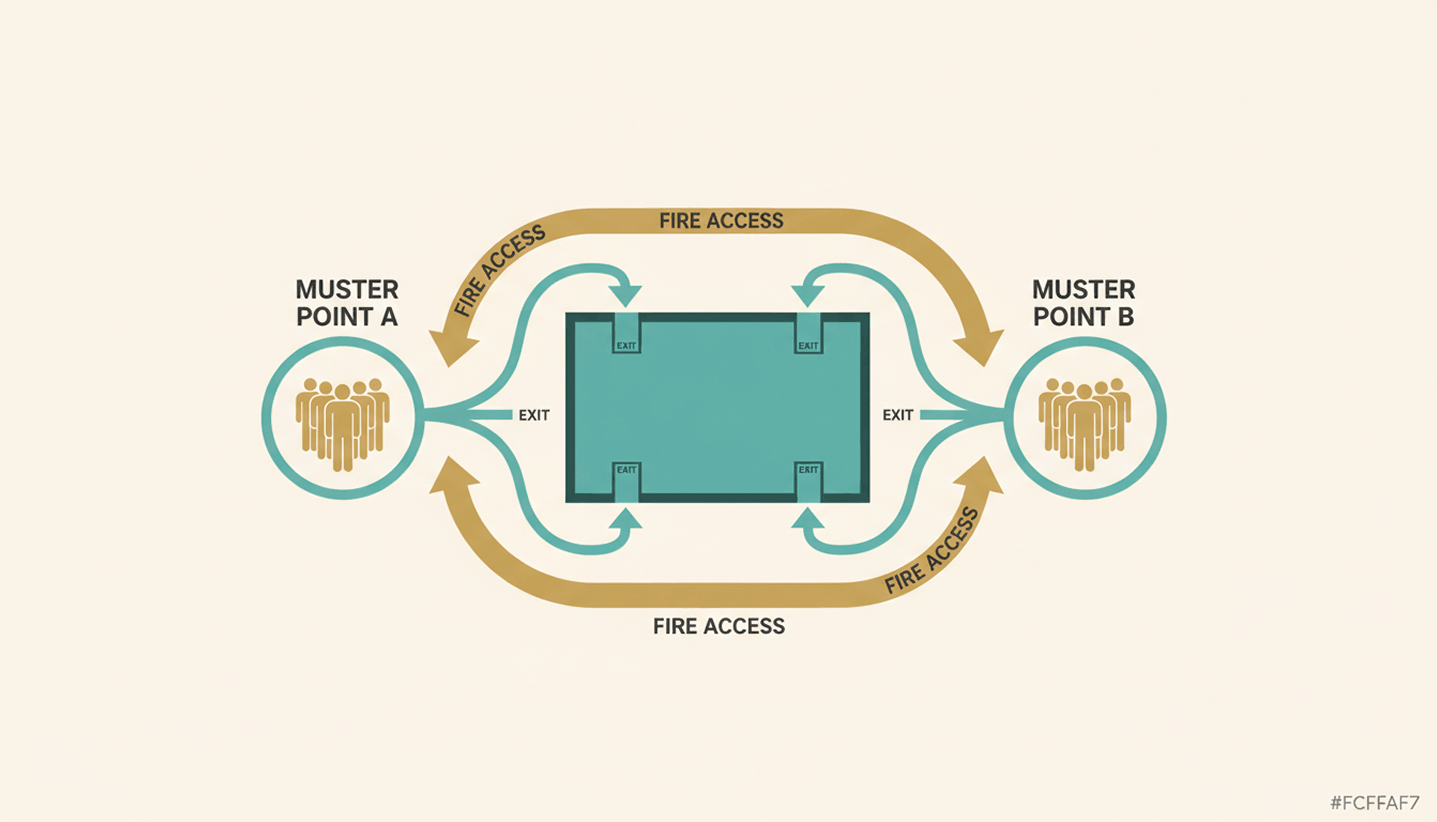
  • Escape and rescue routes: Designation of stairwells and emergency exits that must remain smoke-free in the event of a fire.
  • Fire resistance classes: Use of materials that withstand fire for a defined period (e.g. F90).

Technical fire protection systems

This includes all technical installations that detect a fire early or support firefighting efforts.

  • Fire alarm systems (BMA): Automatic detection of smoke or heat and direct alerting of the fire brigade.
  • Smoke extraction systems (RWA): Extract smoke gases from the building to protect people and improve visibility for evacuation.
  • Emergency lighting: Ensures escape routes can be found in the event of a power failure or smoke.

Organisational fire protection

This is the area with the greatest need for action by office management, as it governs human behaviour and ongoing maintenance.

  • Fire safety regulations: Preparation of parts A, B and C to govern behaviour and responsibilities.
  • Fire safety assistants: Designation and training of employees for initial firefighting and evacuation.
  • Maintenance & inspection: Ensuring inspection deadlines for fire extinguishers, wall hydrants and alarm systems.
  • Briefings: Regular training of all employees on the specific hazards and escape routes in the office.

How many fire extinguishers does my office need?

The number of fire extinguishers required in an office depends on the floor area and fire risk, with normal risk generally assumed for standard administrative buildings. The extinguishing agent unit (LE) system according to workplace rule ASR A2.2 is used to determine the requirement, making the different performance levels of various extinguishing agents comparable.

Step 1: Determining the fire risk

Before calculating the number, the risk class must be determined:

  • Normal risk: Standard offices without high fire loads (e.g. ordinary computer workstations, files in usual quantities).
  • Elevated risk: Rooms with flammable liquids, large storage areas or workshops. Additional measures are required here.

Step 2: Calculating extinguishing agent units (LE)

For offices with normal risk, the following table from the technical rule for workplaces ASR A2.2 (section 5.2, table 3) applies for determining the required extinguishing agent units:

Floor area (up to m²) Required extinguishing agent units (LE)
50 6
100 9
200 12
300 15
400 18
each additional 250 +6

Step 3: Selecting the fire extinguishers

A standard 6-litre foam extinguisher usually corresponds to 6 to 9 LE (depending on performance). The choice of extinguishing agent is important in offices. Get advice from a fire safety company:

  • Foam extinguishers: They extinguish effectively and cause significantly less contamination than powder extinguishers.
  • CO2 extinguishers (carbon dioxide): Mandatory for server rooms or areas with extensive IT hardware, as they extinguish without residue and do not cause short circuits from extinguishing agent residues.
  • Powder extinguishers: Unsuitable for offices, as the fine salt powder permanently damages all electronics and furnishings (corrosion).

Important placement rules for fire extinguishers

  • Accessibility: Fire extinguishers must be clearly visible and easily accessible (maximum distance from any point: 20 metres).
  • Mounting height: The grip height should be approximately 80 cm to 120 cm.
  • Marking: Each location must be marked with the square, red fire safety sign (F001) above the extinguisher.

How many fire safety assistants must be designated for my office?

According to ASR A2.2 section 7.3, the employer is obliged to familiarise a sufficient number of employees with fire extinguishing equipment through instruction and practice and to designate them as fire safety assistants. These persons support initial firefighting and the evacuation of colleagues in an emergency.

  • The 5 percent rule: As a rule, 5% of employees as fire safety assistants is sufficient, provided there is a normal fire risk (which applies to most offices).
  • Attendance: Shift work, holidays, sick leave and mobile working (hybrid work) must be taken into account in the calculation. A sufficient number of assistants must be present on site at all times.
  • Special risk: In cases of elevated fire risk or a large number of persons with limited mobility (e.g. public traffic), the quota must be individually adjusted upwards.
  • Additional roles: It often makes sense to deploy fire safety assistants simultaneously as evacuation assistants to coordinate the building evacuation in a structured manner.

Fire safety assistant training and refresher courses

An employee only becomes a fire safety assistant through expert instruction. This includes:

  • Theoretical foundations: Fundamentals of preventive fire protection, behaviour in the event of fire and the operational fire safety organisation.
  • Practical exercise: Real-world handling of fire extinguishing equipment (extinguishing agent training).
  • Interval: Training should generally be refreshed every 3 to 5 years. In the event of significant operational changes (e.g. relocation or new procedures), immediate retraining is required.

What challenges does modern work pose for fire safety in the office?

The greatest challenge for fire safety in modern office concepts is the lack of overview of the actual number of people in the building, caused by hybrid work and desk sharing. Traditional, static attendance lists are ineffective in such a work environment, as employees appear irregularly, spontaneously switch workstations or leave the office without signing out.

  • In the event of an evacuation, rescue services need to know how many people are in which fire compartments. Paper lists or pure booking data (which often contain "no-shows") lead to life-threatening inaccuracies.
  • With free seating, there is a risk that too many people are in one area at the same time. This can overload escape routes or exceed the maximum permitted occupancy according to the fire safety concept.
  • As teams rotate, permanently assigned fire safety assistants per floor are often not present. It must be ensured that despite hybrid working, a sufficient proportion of trained personnel is always on site.

How do booking software and presence detection help with fire safety in the office?

PULT is our software for workspace and room booking as well as automated presence detection. Smartphones, tablets or laptops are detected via the company Wi-Fi and the associated person is automatically listed as present. This also creates a reliable attendance list for emergency situations.

Unlike pure booking systems, PULT detects the actual presence of employees, enabling precise coordination of evacuations and compliance with legal safety requirements.

  • Emergency report at the push of a button (Emergency Export): Administrators can instantly generate a list of all persons currently present in the office via a button. Since the system automatically detects presence via the Wi-Fi connection of devices, employees who forgot to book a desk are also captured.
  • Automated capacity limits: Maximum occupancy numbers per zone can be set in PULT's booking logic. This prevents overcrowding and ensures that fire safety concepts and escape route capacities are maintained at all times.
  • Vermeidung von Fehlern bei Evakuierungen: Die automatisierte Erfassung beendet das „Ratespiel“ am Sammelplatz. Rettungskräfte erhalten sofortige Klarheit darüber, ob das Gebäude vollständig geräumt ist oder ob sich noch Personen im Gefahrenbereich befinden könnten.
Tip: Learn more about automatic presence detection via Wi-Fi at PULT Presence.

{{onpage-cta}}

Trusted by 1000+ innovative workplaces

Fair in everyday office life and safe in an emergency: workspace booking and presence detection with PULT.

FAQ

Have questions?

How often must fire safety training take place in the office?

The training must be carried out at least once a year. If there are young people under the age of 18 present, the interval is reduced to every six months. In addition, retraining is necessary in the event of significant changes in the company, such as after a move, when new technical equipment is installed, or after a change in fire safety regulations.

Who is authorized to train fire safety assistants for the office?

Training may only be carried out by competent people. These include fire safety officers, occupational safety specialists with the appropriate additional qualifications, or external service providers such as the fire department, professional associations, or certified training centers.

How many fire safety assistants are required in the office?

As a rule, at least 5% of the employees present must be trained as fire safety assistants. However, absences due to vacation, illness, shift work, or mobile working must be considered in the calculation so that the actual quota in the company must be higher to guarantee the presence of 5% at all times.

Is it mandatory to have a fire safety officer in the office?

Legally, a fire safety officer is not usually explicitly required for normal offices. However, it may be required by the building permit, fire insurance, or in the event of an increased fire risk. For buildings larger than 2,000 m² (special structures), however, the appointment of an officer is mandatory in most cases.

Which fire extinguisher is best suited for office spaces?

Foam extinguishers are best suited for traditional office spaces, as they extinguish fires effectively and leave significantly less residue than powder extinguishers. For server rooms or workstations with a lot of IT hardware, CO2 (carbon dioxide) extinguishers should also be provided, as these extinguish fires without leaving any residue and do not damage other electrical equipment.

How can I tell if a fire extinguisher is still operational?

Every fire extinguisher must be inspected by a qualified technician every two years. This is indicated by the yellow or blue inspection sticker on the container, which shows the next maintenance date. In addition, the safety pin must be undamaged, and, in the case of stored pressure extinguishers, the pressure gauge should be in the green range.

Do escape and rescue plans have to be displayed in every office?

Yes, escape and rescue plans must be displayed in clearly visible locations (e.g., hallways, elevators, break rooms) if the layout of the room or the escape route is not obvious. They must be up to date and comply with the requirements of DIN ISO 23601.

About author

Isolde Van der Knaap

Hybrid Work Enthusiast and Account Executive

At PULT we're designing the future of the hybrid workplace for companies and their employees. Focused on SME and mid market customers in Eruope, I'm working on everything from Customer Discovery to Onboarding. I'm very passionate about new work and moved to Hamburg in 2024 even though I'm originally from France.

Resources

Learn how to run better workplace operations

Office Insights

Micromanagement: Consequences, Legal Risks, and the Path to Controlled Delegation

Micromanagement refers to a leadership style in which supervisors closely monitor their team’s tasks and constantly intervene. The consequences range from demotivation and resignations to legal risks arising from organizational negligence. However, by reducing micromanagement and delegating effectively, leaders can improve team performance while simultaneously reducing their own liability risk.

Micromanagement: The Basics

  • Micromanagement is a leadership style characterized by excessive attention to detail and constant interference in the team's tasks. Typical consequences include demotivation, a decline in personal responsibility, and above-average turnover rates.
  • Signs of a micromanaging boss include constant status updates, nitpicking over routine phrasing, requiring everyone to be CC'd on every email, and approval loops for trivial decisions.
  • Micromanagement carries legal risks because unclear responsibilities can lead to organizational negligence, and excessive monitoring of employees may violate § 26 of the Federal Data Protection Act (BDSG).

PULT is an all-in-one office management software solution that provides executives with a data-driven overview of hybrid teams through Office Insights, desk booking, and visitor management, without the need to micromanage operational details.

What is micromanagement, and how can you tell if you or your boss is doing it?

Micromanagement is a leadership style in which supervisors constantly monitor their employees’ performance and constantly interfere in their decision-making. Engaged leadership is clearly different, as it sets clear expectations for the outcome but leaves the path to achieving it open.

From an employee's perspective, the following patterns become particularly evident when a supervisor engages in micromanagement:

  • Routine work is proofread and the wording is fine-tuned—something that should have been done long ago
  • You'll be copied on every email
  • Independent decisions are subsequently called into question
  • We receive several status requests every week, even though clear deliverables have been agreed upon

If you are a manager yourself, ask yourself whether the following statements apply to you:

  • You systematically proofread your team's documents before they leave the office
  • You have routine decisions notified to you before they are implemented
  • You step in whenever tasks aren't handled the way you would handle them yourself
  • You ask for status updates more often than your team can deliver results

If you answer "yes" to several of these questions, it's a clear sign that your leadership style has slipped into micromanagement.

{{hint-box}}

What are the consequences of micromanagement for the team and the company?

The consequences of micromanagement affect both the team and the company:

  • Increased willingness to resign and rising turnover
  • Declining personal responsibility and innovative spirit within the team
  • The risk of burnout among employees is constantly monitored
  • Poorer strategic decisions because managers are bogged down in operational details
  • High follow-up costs due to recruiting, onboarding, and knowledge loss

Studies on willingness to quit, such as the Gallup Engagement Index, consistently show that micromanagement is one of the most common reasons for changing jobs. In addition to the human and economic consequences, the legal risks carry particularly serious weight for German companies.

What legal risks does micromanagement pose for managers?

The legal risks associated with micromanagement are rarely mentioned in HR practice, but they are substantial and affect three areas.

Organizational failure resulting from micromanagement

When a manager makes all decisions on their own, lines of responsibility become blurred. If damage occurs, it is difficult to determine clearly who failed to fulfill which duty. The case law of the Federal Court of Justice requires that tasks, authority, and responsibility be clearly assigned. Micromanagement undermines precisely this requirement.

Employee Data Protection under Section 26 of the Federal Data Protection Act (BDSG)

Close monitoring of employees, such as continuous screen monitoring or constant activity tracking, may violate employee data protection laws. Monitoring measures must be proportionate and based on a specific reason.

Delegation as a form of liability protection

A properly documented delegation of authority protects the manager in the event of a claim. Three steps ensure its legal validity:

  • Assign the written assignment , including specific expectations regarding the outcome.
  • Specify the person’s authority explicitly—that is, which decisions they are authorized to make on their own.
  • Agree on reporting milestones at which interim results will be reviewed.

What is the opposite of micromanagement?

The opposite of micromanagement is controlled delegation, often referred to as empowerment or trust-based leadership. In this approach, the manager transfers responsibility for results to employees and no longer controls the process, but rather the agreed-upon output.

  • Clear agreement on objectives with measurable results
  • A defined scope of decision-making within which employees are allowed to act independently
  • Agreed reporting points instead of constant monitoring

This approach is an absolute must, especially in hybrid teams. When managing remotely, you must shift your focus from presence to results, because you no longer have the ability to visually monitor your team.

Moving Away from Micromanagement: What Should a Manager Do?

Overcoming micromanagement is a process that starts with the leader. If you decide to break this habit, these five steps will guide you toward lasting change:

  1. Conduct a self-assessment: Identify your personal triggers. Do you step in because you’re afraid of making mistakes, because you need to be in control, or because you don’t trust the team’s technical expertise?
  2. Categorize tasks: Sort by importance and urgency. Keep broad, strategic issues on your plate; assign all operational tasks clearly.
  3. Define expectations in writing: Describe the desired outcome, but not the path to get there. This will prevent your team from having to be corrected later on for deviating from the plan.
  4. Establish a reporting schedule: Agree on regular check-ins instead of ad hoc inquiries. Weekly or biweekly meetings replace the constant back-and-forth about status updates.
  5. Use tools to stay organized: Software that shows you at a glance who is working where, when office hours are scheduled, and when teams are meeting eliminates the need to constantly ask around.

How to Lead Your Hybrid Team with PULT Without Micromanaging

Micromanagement is a leadership style that comes at a high cost. It drives good employees to quit, undermines the quality of decision-making within the team, and creates legal risks related to organizational negligence and data protection.

The solution lies in controlled delegation. Clear goal agreements, defined decision-making authority, and agreed-upon reporting points replace constant micromanagement. In hybrid teams, the right tools help ensure that you maintain an overview without micromanagement. With PULT, you can keep track of everything without micromanagement:

  • Real-time overview without having to ask: With PULT Presence, you can see on a digital office map who is currently on-site and who is working remotely. Check-in happens automatically via the company Wi-Fi, so you don't have to ask anyone.
  • Weekly planning right in your calendar: Scheduled days in the office and working from home appear in Outlook and Google Calendar, so you don't have to track status emails. Team days can be scheduled fairly and proactively based on this information.
  • Answers at the touch of a button instead of endless back-and-forth: The AI assistant instantly answers questions like “Who’s in the office tomorrow?” via a simple chat interface. No group emails, no follow-ups, no micromanagement.

Automatic synchronization with your HR system: Vacation and absence data from Personio or HiBob is automatically imported into PULT. You can plan team events based on up-to-date information, rather than manually collecting availability data from team members.

{{onpage-cta}}

Office Insights

Macro Management: Definition, Benefits, and Guide for 2026

Macro-management is a leadership style in which managers set overarching goals and guidelines rather than micromanaging day-to-day details. This approach is gaining importance as hybrid teams, new compliance requirements, and increasing reporting pressures push traditional micromanagement to its limits.

Macro Management: The Basics

  • Macro-management is a leadership style in which managers set strategic goals, a vision, and resources, and delegate the operational implementation to teams.
  • Unlike micromanagement, macromanagement relies on personal responsibility and focuses on results rather than individual tasks.
  • Macro-management is a preferred leadership practice in larger companies that face increasing reporting pressures due to hybrid teams and compliance requirements such as CSRD or NIS-2.
  • PULT handles day-to-day office management—including desk and room booking and workplace insights—so that executives have more time to focus on strategic management.

What is macro-management? 

Macro-management refers to a leadership style in which managers steer the company through vision, overarching goals, and resource allocation. They delegate day-to-day operational tasks to teams that make independent decisions within a defined framework. The focus of leadership is on the outcome rather than on individual steps.

At the management level, macro-management is part of strategic leadership—that is, the highest level of corporate management. Below that are tactical management (division management, quarterly planning) and operational management (day-to-day business, process control). Under the macro-management approach, you largely stay out of the lower two levels.

Unlike laissez-faire (French for “let it be”), macro-management requires established guidelines, sets clear expectations, and schedules regular reviews. Within this structure, however, the team makes its own decisions. If you mix the two, you could slip into micromanagement or cause confusion within the team.

What is the difference between macro-management and micro-management?

The biggest difference between macro-management and micro-management lies in whether, as a manager, you control your employees’ results or their work processes. Micro-management focuses on the how, while macro-management focuses on the what and why.

Micromanagement isn't inherently wrong. In crisis situations, when onboarding new team members, or when dealing with highly regulated processes, close oversight makes sense.

What are the benefits of macro-management for hybrid teams?

Macro-management works for distributed teams because the underlying focus on results is not tied to a specific location. Work outcomes can be measured equally well regardless of whether employees work in the office, remotely, or prefer a hybrid approach. Micromanagement, on the other hand, fails due to the sheer logistics of hybrid setups.

A second benefit is that it takes the pressure off managers. Instead of checking daily office routines and individual tasks, they have time to focus on strategic issues. These include, above all, CSRD reporting, AI governance in accordance with the EU AI Act, and cyber compliance under NIS-2.

Third, macro-management reduces bottlenecks. When every decision has to go through a manager’s desk, it can bring an organization of a certain size to a standstill. Delegating decision-making authority, on the other hand, spreads the load.

Where does macro-management reach its limits?

Macro-management reaches its limits in situations where your team needs clear instructions rather than being left to take initiative on their own: during the onboarding phase for new employees, in acute crisis situations such as cyberattacks, and in highly regulated processes with audit requirements. In these three scenarios, close supervision is the appropriate leadership approach.

  • New team members with no experience need clear instructions and closer guidance. Anyone who assigns full responsibility to someone without proper training risks overwhelming them and leading to poor decisions. In this case, a hybrid approach combining coaching and selective micromanagement is more appropriate.
  • In acute crises, such as security incidents or cyberattacks, quick and clear leadership is essential. Consensus-based decisions take time, which is simply not available in such moments. Macro-management is counterproductive in this context.
  • Highly regulated processes such as compliance audits, data protection approvals, or financial approval processes require micromanagement in accordance with established guidelines. Deviations made on one’s own initiative tend to pose a risk in these cases. In such situations, macromanagement can serve as the default approach, while micromanagement can be used as a deliberate exception.

Guide: How Do I Implement Macro Management?

Implementing macro-management means first setting overarching goals, then delegating decision-making authority, automating routines where possible, establishing review cycles, and finally building a robust database. Each of these five steps is a prerequisite for the next:

  • Step 1: Define strategic goals and guidelines. Set clear OKRs or KPIs for quarters and years. The team needs to understand what their work contributes to. Without this focus, macro-management quickly devolves into laissez-faire.
  • Step 2: Explicitly delegate decision-making authority. Document which decisions the team makes on its own and which ones are escalated to management. A RACI matrix or a simple list of responsibilities works well for this.
  • Step 3: Automate operational routines. Desk booking, room reservations, and visitor management don’t belong on a manager’s desk. Your focus should be on numbers and analytics.
  • Step 4: Establish review cycles. Regular one-on-one meetings, monthly team reviews, and quarterly strategy reviews form your framework.
  • Step 5: Build a data foundation. Far-reaching decisions become sound when real data is available. Office utilization, attendance patterns, compliance reports, and ESG metrics provide the foundation for senior management.
Tip: With PULT Presence, you can track your teams' attendance automatically without needing their help. Get occupancy data and analyze the utilization of your workspaces.

How does macro-management work with remote work and hybrid teams?

The ability to manage the big picture in a hybrid office environment depends on what data is available to senior management for making decisions about space, teams, and compliance.

In a hybrid work environment, office occupancy fluctuates from day to day, as there are almost always some colleagues working remotely. Some popular areas of the office remain consistently overcrowded, while others are nearly empty. Without concrete data on this, your planning will be based more on daily impressions than on actual evidence.

Attendance data, room booking patterns, and visitor traffic are therefore essential to your management.

This is particularly evident in ESG reporting. The CSRD (Corporate Sustainability Reporting Directive) requires companies above a certain size to report data on, among other things, office occupancy and energy consumption. If you already track these metrics automatically in your office management system, you can easily transfer them directly into your reports.

For office managers and workplace coordinators, this means that hybrid work and macro-management work best together when you collect data at the grassroots level—and do so as automatically as possible.

Here's how to automate macro management with PULT

Macro-management requires data. After all, unless you know how spaces are being used, who is on-site and when, and which areas are chronically empty or constantly overcrowded, you’ll be making decisions based mainly on guesswork or, at best, half-hearted headcounts. PULT collects all this data automatically and in compliance with GDPR.

PULT Presence serves as the foundation for this: The system automatically detects which employees are actually in the office via the Wi-Fi connection of their laptop or smartphone. No check-in, no manually maintained list, no required responses.

This data is fed directly into PULT Workplace Analytics. The result is reliable reports on the actual utilization of spaces, rooms, and zones. You and your managers can see which areas are consistently underutilized, which bookings are regularly left unused, and how utilization patterns evolve over months and quarters.

You can request reports from the AI assistant by saying: “Give me the occupancy report for Building A from last week.”

  • Automatic presence detection: The Wi-Fi signal detects who is in the office without the need for check-ins or manual lists within the team
  • Workplace Analytics: Occupancy reports for spaces, rooms, and zones as a basis for real estate and ESG decisions.
  • AI Scenario Planning: Simulate how staff growth or new hybrid models will affect your space requirements.

AI Assistant: Generate reports on command via chat, without having to search through the dashboard or the data yourself.

Real data and analytics for your macro management!

  • ✓ Get real-time data on attendance and utilization in PULT. Make informed decisions that you can back up with evidence.
Start free trial
Desk Booking

Desk Sharing and Personal Belongings: Rules, Storage, and Compensation

How to handle personal belongings in a desk-sharing environment is one of the most emotionally charged issues when introducing flexible workspaces. A clean desk policy requires employees to completely clear their desks every day, including photos and favorite mugs. True acceptance only emerges when legal frameworks, storage solutions, and cultural considerations work in harmony.

Desk Sharing and Personal Belongings: The Basics

  • With desk sharing, personal items must be cleared from the desk at the end of each workday because the Clean Desk Policy requires that the desk be cleared for the next person.
  • An employer may implement a clean desk policy as a directive, but may not impose a blanket ban on personal items that fall under the general right to privacy, and the works council has a right of co-determination under Section 87 of the Works Constitution Act (BetrVG).
  • The three established storage solutions are lockable lockers for personal items, mobile rolling containers used as desk-sharing organizers for work supplies, and daily customization followed by storage.
  • PULT is an all-in-one office management software solution that allows companies to book and manage desks, lockers, parking spaces, and catering centrally within a single application.

What rules can be established regarding personal belongings in a desk-sharing arrangement?

In a desk-sharing arrangement, the employer may issue instructions requiring employees to clear their desks daily, lock away all documents, and store personal belongings in designated lockers. However, the employer may not dictate which personal items are generally permitted. Personal rights and the works council’s right to co-determination set clear limits.

What regulations regarding personal belongings are legally permissible?

The Clean Desk Policy constitutes a directive under labor law pursuant to § 106 of the Trade Regulation Act (GewO). The employer establishes rules regarding order and hygiene in the office because the shared resource desk is available to multiple employees in a desk-sharing arrangement.

Guidelines regarding the proper disposal of documents, notes containing personal data, and security-related information are permitted. Article 32 of the GDPR requires this anyway. If someone on your team leaves job applications, contracts, or health data lying around, that person is violating the obligation to ensure technical and organizational security.

A blanket ban on personal items during working hours is not permitted. Photos, plants, and mugs are protected under general privacy rights. The rules should therefore be included in a desk-sharing company agreement with the works council.

When must the works council give its approval?

The works council must always approve desk sharing because Section 87(1)(1) of the Works Constitution Act (BetrVG) provides for mandatory co-determination regarding workplace regulations and employee conduct. This includes the clean desk policy, booking rules, and locker allocation.

Without a works council agreement, the clean desk policy cannot be enforced; unilateral directives are subject to challenge and often fail in conciliation proceedings.

Therefore, involve the works council during the planning phase, before ordering any furniture. Involving them early on is more likely to result in practical, workable policies, especially if you want to introduce desk sharing.

What storage options work best for personal belongings when sharing a desk?

Three storage solutions have proven effective for personal items in desk-sharing environments: lockable lockers for personal belongings, mobile rolling carts to organize work supplies, and the option to personalize your workspace for the day and then pack everything away into a backpack or bag.

How can I make up for the loss of my own desk when sharing a workspace?

The most effective way to compensate for the loss of a personal desk is to offer alternatives that match or exceed the comfort of having one’s own desk. A high-quality, well-equipped office kitchen, a lounge area that’s pleasant to spend time in, and complimentary perks like snacks and drinks shift the focus from personal desk space to a positive workplace experience.

Employees who have had to give up their personal coffee makers or kettles as part of the desk-sharing initiative are more likely to accept this if the new kitchen is better equipped and the office is properly designed. High-quality coffee stations, ample refrigeration options, and a varied selection of snacks make the transition easier.

Since desk sharing reduces the space required for individual workstations, it creates room for these upgrades. Companies typically reduce their desk space by 30 to 45 percent and invest the freed-up square footage in lounges and break areas, among other things. The goal may be to create a clubhouse-like atmosphere, which is significantly shaped by the right desk-sharing equipment in the workplace.

4 Steps to Mastering Desk Sharing and Personal Belongings

The practical implementation is carried out in four sequential steps: first, the infrastructure; then, legal coordination; followed by internal communication; and finally, the booking system.

  • Step 1: Storage infrastructure should be set up before the transition. Lockers, mobile rolling cabinets for desk sharing, and kitchen equipment should be available.
  • Step 2: Establish rules in a company agreement with the works council. The agreement covers the clean desk policy, booking windows, locker allocation, and procedures for violations.
  • Step 3: Actively inform employees about what they stand to gain. Let your team know what benefits will replace the fixed desk.
  • Step 4: Implement a booking system that consolidates desks, lockers, and resources.

Here's how to offer desk sharing and all your office services in a single software platform

If you provide lockers, rolling cabinets, kitchens, and relaxation areas , it will be easier for your staff to transition to desk sharing. The most important thing is to ensure fairness in the allocation of all new office resources: Every employee must be able to rely on the fact that the desk they booked is actually free when they arrive. The same applies to meeting rooms and reserved zones. You can achieve this fairness with PULT.

  • Planning certainty before heading to the office: Desks, rooms, zones, and parking spaces can be reserved in advance to avoid any conflicts.
  • Automated No-Show Management: PULT Presence uses the office Wi-Fi to determine whether a reservation has actually been honored. If someone does not show up after the grace period, the space is automatically released, making ghost bookings and holding spaces unnecessarily a thing of the past.
  • Set booking rules: You set rules for zone access, booking priorities and maximum advance booking periods, so that no team permanently monopolizes capacity.

Real-time office layouts: The digital floor plan shows who has booked which space and where everyone is seated. This makes it easy to sit next to your teammates.

{{onpage-cta}}