10 Tipps, um Kosten im Unternehmen zu senken
.avif)

Get your expenses and contracts under control immediately
Stop unnecessary renewals:
- Identify all contracts and subscriptions with automatic renewal.
- Check cancellation periods and set reminders for 30/60/90 days before expiration.
- Cancel unused or redundant services immediately.
Tighten approvals for expenses:
- Introduce an additional approval for purchases above a defined amount (e.g., $500 or $1,000).
- Temporarily put a stop to new software, consulting services, or agency contracts until the need has been clearly established.
Quickly improve cash flow
- Identify the largest outstanding invoices and set up reminder and clarification processes.
- Define clear payment terms for new customers.
- Identify excess inventory and slow-moving items and review sales or return options..
Reduce cloud costs
- Reduce oversized subscriptions based on actual CPU, memory, and network usage.
- Automatically shut down development and test environments outside of working hours.
- Use reservations or savings plans when workloads are stable.
- Set tags for cost centers, projects, and teams.
- Set up dashboards that show costs per service, team, or product.
- Implement a monthly cloud review with savings targets.
Reduce space and office costs
Office and space costs are among the largest fixed cost blocks for many companies. Due to hybrid working models, i.e., switching between the office and working from home, many workplaces are permanently underutilized.
1. Record actual land use
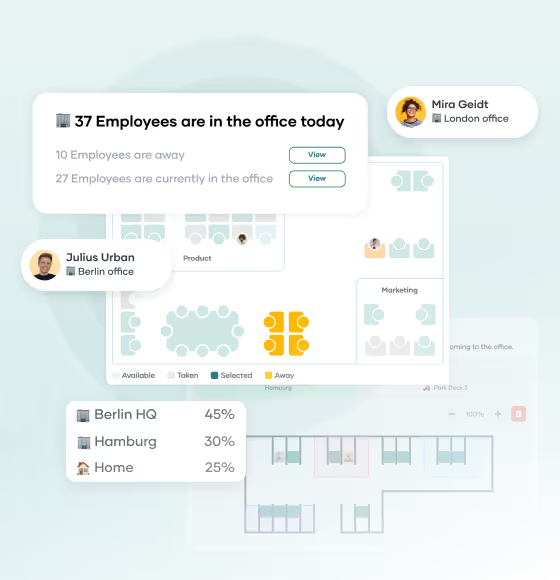
- Evaluate bookings, but above all, genuine access data/Wi-Fi logins to determine truly reliable usage rates. The easiest way to do this is with PULT Presence, as your employees do not need to take any action.
- Check utilization by day, team, and area to identify peak and off-peak times.
- Document occupancy over several weeks to rule out seasonal effects.
2. Optimize use of office space
- Based on usage data, you can determine how many individual workstations you actually need to provide, always in conjunction with the desk sharing quota.
- By combining the now reduced number of individual workstations, you can already save on cleaning, heating/cooling, and ventilation costs.
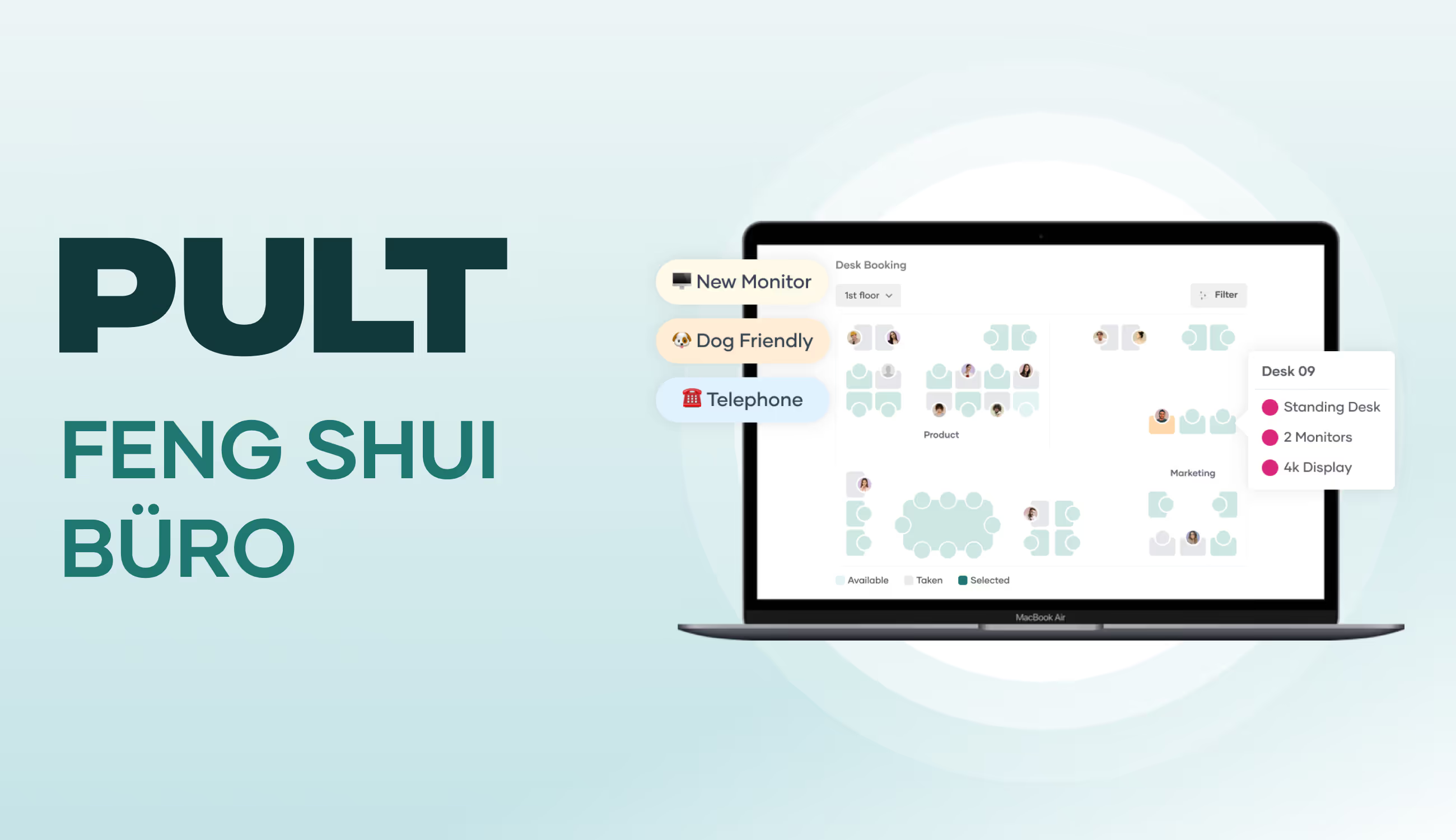
- Tip: Using the room booking feature in PULT, you can see exactly when meeting rooms are needed and therefore need to be operated. This also saves on ancillary costs.
- Thanks to the reliable data, you can now make better use of these office spaces, which makes them cheaper per employee.
- Check whether areas or floors can be reduced or closed in the medium term. If rental agreements allow this, offer permanently unused space for temporary or subletting.
- Tip: This allows you to offer parts of your office space for external use, for example as a co-working space. This generates additional income.
Reduce energy costs
Energy costs are a significant cost factor. Due to rising grid fees, CO₂ pricing, and the requirements of the Energy Efficiency Act (EnEfG).
Reduce energy consumption
- If possible, put devices on standby or switch them off completely.
- Activate night and weekend shutdowns for lighting, ventilation, and IT peripherals.
- Check heating curves and room temperatures and adjust them to actual requirements.
- Update timer programs and sensors so that they reflect realistic usage times.
Technical measures
- Convert conventional lights to LED if you haven't already done so.
- Add motion and presence detectors in hallways, restrooms, and meeting rooms.
- Have a hydraulic balancing carried out if the heating system is operating inefficiently.
- Review your server costs and migrate to a cloud solution if possible.
Subsidies and energy audits
- Conduct a BAFA-funded audit to identify potential savings. Use the results as a basis for investment decisions and action planning.
- KfW offers programs for energy efficiency in buildings and production. Look out for combinations of grants and low-interest loans.
Purchasing & Supplier Management
Your purchasing has a significant impact on the cost structure. Enter into negotiations on prices, contract terms, and supplier structures.
Get a complete overview of all purchases
- Download invoices from the last 12 months from your accounting system.
- Sort them by category: IT, office supplies, services, marketing, energy, etc.
- Mark suppliers from whom you order regularly.
You can quickly identify areas with high costs. Often, a small number of suppliers account for the majority of the budget. This is precisely where the greatest potential for savings lies.
Compare prices and check alternatives
- Obtain at least two to three comparative quotes for your most important products and services.
- Check whether better prices can be achieved by bundling quantities.
- Watch out for hidden costs such as delivery fees or additional services.
For services such as IT support, cleaning, or advertising technology, it is almost always worthwhile to compare prices annually, as the price differences are often considerable.
Reorganize orders and review contracts
- If you purchase the same products from different suppliers, bundle these purchases.
- Focus on a few reliable partners and thereby increase your purchasing volume, which will strengthen your negotiating position.
- Negotiate longer payment terms to improve your liquidity.
- Remove unused services from existing contracts.
Improve liquidity
By taking measures in the areas of receivables, inventories, and liabilities, you can improve your liquidity without shifting costs to other areas or compromising performance.
Collect outstanding receivables
- Create a list of all overdue invoices and sort them by amount and due date.
- Contact the most important customers by phone.
- Clarify any outstanding issues in person and agree on fixed payment dates.
Optimize payment terms:
- Use shorter payment terms for new customers, e.g., 7 or 10 days.
- Issue invoices immediately after services have been rendered.
Check stock levels and order quantities
- Identify items that have been sold or used little or not at all for a long time.
- Mark excess stock, perishable goods, or products with long turnaround times.
- Update minimum stock levels if they no longer match actual demand.
- Stop automatic reorders for slow-moving items.
- Plan sales or bundle promotions to free up storage space.
- Check return or exchange options with the supplier.
Processes, tasks, and automation
Your internal processes can be cost-reducing, especially if they have not been reviewed for a long time.
Remove unnecessary steps
- Record the most important processes in your company (e.g., quotation preparation, invoice verification, support requests, onboarding).
- Mark steps that frequently cause queries, waiting times, or rework.
- Check which tasks are performed multiple times or for which responsibilities are not clearly defined.
Automate tasks
- Standard tasks such as data entry, appointment confirmations, reminders, or status notifications can often be automated.
- Check tools that are already in use. Many offer automation features that are rarely used.
Typical automation examples:
- Automatic invoice approvals for clear amounts or clear rules
- Automated reminders
- Digital form processes (e.g., vacation requests, onboarding)
- Automatic updates of customer or supplier data
- AI for responding to support requests. Many simple customer questions can be intercepted and clarified with it. Your team can then deal with cases that actually require expert advice.
Managing personnel costs without layoffs
The goal should be to keep personnel costs stable and predictable without compromising productivity or quality. Job cuts should be a last resort, as hiring well-trained personnel at a later date is both difficult and expensive.
Involve the team
- Share with your team which cost blocks are increasing and where there is a need for savings.
- Make it clear that the goal is not to cut jobs, but to secure them.
- Actively ask employees for suggestions: Many cost drivers are well known to them from their everyday work.
Your openness creates understanding and motivation. And lots of small ideas from the team usually lead to noticeable savings.
Review collaboration with freelancers and service providers
- Regularly analyze which external forces are permanently in use.
- Check whether tasks can be handled more cheaply and reliably internally.
- Reduce external support when it is not absolutely necessary.
Reduce overtime and extra work
- Check why overtime is occurring and whether it can be avoided.
- Plan layers and tasks so that work peaks can be identified in advance.
- Clarify responsibilities so that tasks are not performed multiple times or inefficiently.
- Avoid overlap between departments or functions.
Working on internal productivity
- Remove unnecessary steps from processes.
- Simplify your internal communication. Reduce the number of meetings your team has to attend.
- Use automation for repetitive or administrative tasks.
- Offer training courses that reduce errors or speed up processes.
Staff reductions as a last resort
- First, examine internal optimizations, process improvements, automation, and the use of external resources.
- Assess the long-term consequences of job cuts: loss of expertise, reduced stability, and high replacement costs.
- If downsizing is unavoidable, plan it in a structured and socially responsible manner.
- Principle: A stable, well-coordinated team is more valuable than short-term savings achieved through cutbacks.
Reduce insurance costs
Insurance is important, but it is one of the expense categories where companies often pay too much, for example through duplicate coverage, outdated rates, or claims coverage that no longer fits the current company structure.
- Record all insurance policies: Review terms, coverage amounts, deductibles, and types of insurance.
- Identify and remove duplicate insurance policies: Check for overlaps between liability, financial loss, cyber, or building insurance policies.
- Adjust deductibles: Higher deductibles can significantly reduce premiums, but only in cases where damage occurs infrequently.
- Review coverage amounts and benefits: Remove oversized or unnecessary additional components and adjust insurance amounts to the actual risk.
- Compare different insurers regularly: Get new quotes every year and check for discounts through bundling or longer contract terms.
{{onpage-cta}}
Where should I start when it comes to cost reduction in the company?
Start with a complete overview of your expenses for the last 6 to 12 months. Focus on the largest cost blocks: personnel, rent/space, energy, IT, and external services. This will form the basis for all further considerations.
Which measures bring the fastest savings?
Typical immediate measures include stopping automatic contract renewals, reducing overtime, comparing supplier prices, and introducing nighttime shutdowns for energy consumers.
How can I reduce personnel costs without laying off employees?
Reduce external service providers, minimize overtime, simplify internal processes, automate routine tasks, and review the internal distribution of tasks. Job cuts are the last resort, as subsequent new hires are expensive and difficult.
What savings potential is there in the office or in terms of space?
Analyze office utilization using booking data and, above all, actual usage data. Underused rooms can be reduced, merged, or sublet. Desk sharing and booking rules often lead to measurable savings.
How can I reduce insurance and risk costs?
Check coverage, deductibles, and double insurance. Remove unnecessary components, regularly compare providers, and invest in simple preventive measures such as IT security or fire protection so that you can also increase your deductible.

About the Author
A new hybrid workplace experience is coming. Start Now. 🎉
Use office space wisely, reduce it, or rent it out. Get started with PULT now.